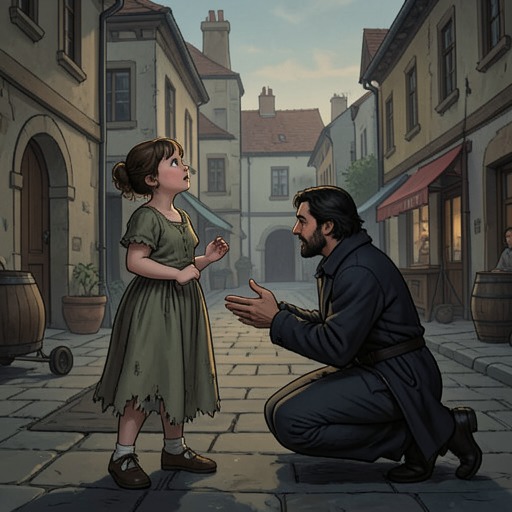
Il tentativo di abuso di Ricardo Uribe
Senza sangueRicardo Uribe’s attempted abuse of Nina unfolds within a relationship he has already shaped around dependence and control. Nina remembers him as the pharmacist who took her from an orphanage when she was eleven, claimed she was his daughter, and made himself the center of her daily life; the later assault therefore breaks through the surface of a household that had seemed almost ordinary.
A Child Taken into His Care
Nina recalls that her earliest memory was of a kind of orphanage. Ricardo Uribe arrived in the countryside village where she was living, with no wife or relatives, and took her in. He told the local people that Nina was his daughter, and they believed him, though he had been there only a few months. The false family identity gave him a socially accepted place as her guardian while leaving Nina dependent on his account of who she was and where she belonged.
During the day, he kept her in the back room of the pharmacy. He taught her between customers and said that anything worth learning could be learned from him. He did not like her going about alone. Nina describes a life in which instruction, shelter, and restriction came from the same adult: she had her own room, helped keep the pharmacy and house clean, washed clothes, and cooked. The domestic routine made his authority seem like care, even as it narrowed her world to the places and tasks he controlled.
Intimacy and the Attempted Assault
At night, Uribe sat on the sofa and had Nina lie beside him with her head in his lap. He told her strange stories about the war and stroked her hair slowly. Nina recalls sensing his sexual arousal beneath his trousers. He would then kiss her on the forehead and let her go to bed. In her account, the gesture of paternal affection sits uneasily beside the bodily awareness she records; the boundary was already charged before he openly crossed it.
One evening, Uribe leaned over and kissed Nina on the mouth. He continued kissing her while putting his hands under her skirt and touching her. Nina says she did nothing. Then, abruptly, he pulled away, began to cry, and asked her to forgive him. His sudden terror and remorse interrupt the assault but do not undo it. Nina did not understand his reaction at the time, and her recollection preserves that gap between what happened to her and what she could make of it as a child.
Aftermath and Nina’s Retrospective Account
A few days later, Uribe told Nina he had found her a fiancé: a young bricklayer from nearby Rio Galvan, whom she would marry when she was old enough. Nina went to see him in the village square the following Sunday. She remembers him as handsome, tall, and very thin, moving slowly, perhaps because he was ill. They greeted one another, and she returned home. The proposed marriage follows closely after Uribe’s attempt to abuse her, but Nina does not explain his purpose; the account establishes the sequence without claiming more than she knew.
Years later, Nina tells the story plainly and calls it one story among others. Its understated presentation sharpens the contrast between the child’s limited understanding and the adult narrator’s knowledge of what took place. She remembers Uribe’s care, his restrictions, his touch, the assault, his crying apology, and the fiancé he selected, while also making clear that she did not then understand why he had behaved as he did. The episode shows how an apparent family bond could conceal a breach of trust, and how Nina’s later telling can name the event without pretending that she possessed its meaning at the time.